

Quick Summary
Halal pick n mix is a sweet selection made without ingredients Muslim consumers avoid, most often pork-derived gelatine and alcohol-based flavourings. Buying it with confidence means checking the certification, reading the full ingredients list, and asking how the sweets are handled and packed.
- Check that a certificate names the certifier and covers the specific sweets you are buying.
- Gelatine often appears without a stated source, so an unverified source means the product is not confirmed as halal.
- Look for carmine, cochineal and E120, which are insect-derived red colourings.
- Ask how pick n mix is scooped and packed, since shared scoops can cause cross-contamination.
- Check the ingredients on the pack you receive, because formulations can change between batches.
Table of Contents
- What Halal Pick n Mix Means and Why Ingredients Matter
- Step 1: Check for a Recognised Halal Certification
- Step 2: Read the Ingredients List for Gelatine and Other Concerns
- Step 3: Look Out for Cross-Contamination and Handling
- Step 4: Build a Balanced Mix Across Sweet Types
- Step 5: Choose a Reputable Online Retailer
- Storing, Serving and Ordering the Right Quantity
- Ordering Your Halal Pick n Mix With Candeeloot
- Frequently Asked Questions
What Halal Pick n Mix Means and Why Ingredients Matter
Last Updated: 14 November 2026
Halal pick n mix is a sweet selection where every item is prepared without ingredients that Muslim consumers avoid, most often gelatine derived from pork and alcohol-based flavourings. Choosing it well means checking more than a label that says "halal", because sweets are one of the most ingredient-heavy snacks on the shelf.

Confectionery is a surprisingly complicated category. Gummies, chews, marshmallows and jelly sweets often rely on gelatine for their texture, while sour coatings, glazes and flavourings can contain alcohol or animal-derived additives.
Interest in halal food is growing, and researchers are paying attention to how consumers judge what is genuinely suitable. A 2025 study on halal literacy found that understanding halal requirements is linked to how interested people are in buying halal products (Al Zahro et al., 2025).
Step 1: Check for a Recognised Halal Certification
Start with certification, but treat it as a question rather than a tick box. A halal logo tells you that an independent body has assessed the product, its ingredients and the production line against its own standard. It does not tell you which standard, and certifiers differ in what they will and will not accept. That distinction is the part most product pages leave out.
Certified versus described as suitable
There is a real difference between a product that carries a certification mark and one a retailer describes as "suitable for a halal diet". The first means an external body has audited the supply chain. The second is the seller's own judgement, which may be well informed but is not independently checked. Neither is automatically wrong, but they are not the same level of assurance, and a page that uses the word "halal" without saying which one it means is worth querying.
What a certification audit typically covers
When a certifier assesses a confectionery line, the checks usually run across four areas:
- Ingredients and suppliers, each raw material, including gelatine, emulsifiers, glazing agents and flavourings, is traced to its source and assessed against the standard.
- Production equipment, lines, tanks and utensils are checked for shared use with non-halal materials and for the cleaning regime between runs.
- Storage and transport, segregated storage and sealed transit are reviewed so that certified stock is not mixed with uncertified stock.
- Labelling and traceability, the certifier checks that the mark is applied only to products within the scope of the certificate and that batches can be traced.
A certificate normally has a scope and an expiry date. If a retailer cannot tell you which body issued the certificate, what it covers and when it was last reviewed, that is your signal to ask more questions before ordering.
Bodies you may see on confectionery
The Halal Monitoring Committee (HMC) is one of the bodies that appears on products sold in the UK, and some retailers state that their collections are HMC certified. Other certification bodies operate to their own standards, and a product may be certified by one and not recognised by another.
Watch out: certification can lapse or a formulation can change between batches, so a logo on last year's packaging is not proof that the current batch is covered. Check the certificate date and the ingredients on the pack you actually receive.
Certification is the strongest single assurance available, but it does not replace reading the label. Move on to the ingredients list with the certificate as your starting point, not your finish line.
Step 2: Read the Ingredients List for Gelatine and Other Concerns
Once you have a certified product, read the ingredients list as a set of questions rather than a list of banned words. Each ingredient below appears in ordinary confectionery for a reason, and knowing the reason helps you judge whether a label is clear or merely quiet.
Gelatine
Gelatine is a gelling agent that gives gummies, marshmallows, foam sweets and many chewy fruit sweets their bounce. It is usually derived from pork or beef, and the label often says only "gelatine" without naming the source. Where the source is not stated, the product cannot be assumed to be halal on the strength of the word alone. Vegetarian alternatives such as pectin, starch and agar are sometimes used instead, and a sweet made with those will normally say so.
Alcohol
Alcohol can appear as a solvent or flavour carrier, and it may not be declared as "alcohol" on the label. Flavourings described only as "flavouring" or "natural flavouring" can be carried in an alcohol base, which is why the source of a flavouring matters as much as the word itself. If a product page does not say how a flavouring is carried, ask before you buy.
Carmine (E120)
Carmine is a red colouring derived from insects. It appears on labels as "carmine", "cochineal" or "E120", and it is used in some red and pink sweets. It is not always obvious from the front of the pack, so check the full ingredient list rather than the flavour name.
Glycerine and emulsifiers
Glycerine (also listed as glycerol) and emulsifiers such as mono- and diglycerides can be derived from animal or plant sources. The label rarely states which. Where the source is not given, the manufacturer's halal statement is the place to look, and a certifier's scope should confirm whether the ingredient was assessed.
Glazing agents
Glazing agents are applied to sweets to stop them sticking and to give a shine. Some are plant-derived and some are not, and the label may name the agent by its E number only. A short E number is not automatically a problem, but it is not automatically fine either, the certifier's assessment is what settles it.
How to read a label in practice
Work through the list in this order:
- Look for a named gelatine source. If none is given, treat the product as unverified until the manufacturer confirms it.
- Check whether flavourings are described in enough detail to show their carrier.
- Scan for carmine, cochineal and E120 by name and by number.
- Note any glycerine or emulsifier without a stated source, and check the manufacturer's halal statement.
- Compare the ingredients on the pack you receive with the ones shown on the product page, since formulations change.
Watch out: a product described as vegetarian is not automatically halal, and a product described as halal is not automatically free of allergens. The two checks are separate, and both belong in your routine.
If the source of an ingredient is unclear, contact the retailer before ordering. A short message is quicker than a disappointing delivery, and a seller who can answer clearly is showing you how carefully the rest of the order is likely to be handled.
Step 3: Look Out for Cross-Contamination and Handling
A halal sweet can still be compromised after it leaves the factory. Cross-contamination happens when halal and non-halal products share equipment, scoops or packing areas without proper separation.
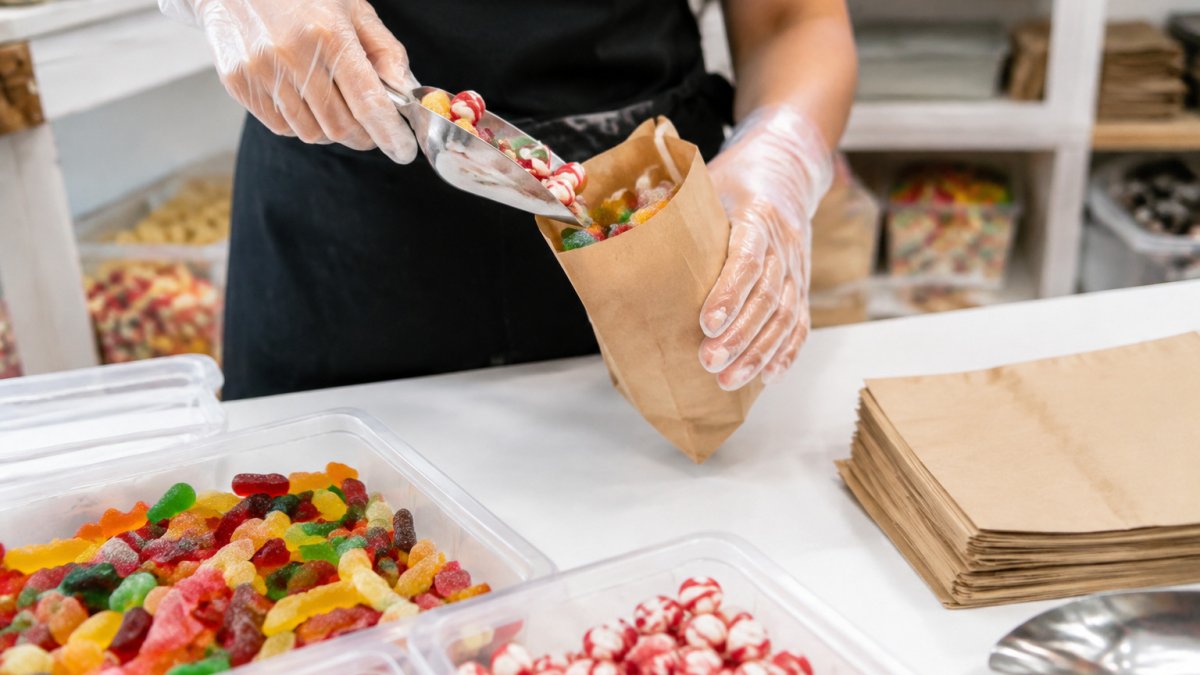
This matters most in shops where sweets are scooped by hand from open jars. Ask how the pick n mix is filled and whether separate scoops and tongs are used. Packing also matters. Sealed, pre-packed bags reduce the risk of mixing, while loose sweets from a shared tray carry more uncertainty.
When you order online, look for a clear statement about how orders are packed and whether halal-only packing areas are used.
Step 4: Build a Balanced Mix Across Sweet Types
Once you know your sweets are suitable, the fun part begins. A good mix balances textures and flavours so that every handful is interesting.
A simple way to plan is to choose across these categories:
- Fizzy sweets for a sharp, lively start, such as sour apple or blue raspberry
- Fruity sweets like strawberry and cream or fruit flavours
- Chewy sweets for something to savour
- Jelly sweets such as cola bottles or peach rings
- Foam sweets and bubblegum for a playful finish
Plan for variety rather than sticking to one favourite. A mix of three or four sweet types usually feels more satisfying than a bag full of one texture. If you are buying for a group, check the dietary notes on each item, since vegetarian and vegan options are not always labelled the same way.
Step 5: Choose a Reputable Online Retailer
The retailer matters as much as the sweet. Look for a seller that states its halal policy clearly, names its certifier, lists full ingredients and explains how it packs orders.
Check the basics before you buy:
- Clear halal certification on each product or collection
- Full ingredients and allergen information
- Transparent delivery times and packaging details
- Reviews from real customers, such as the Trustpilot reviews for Candeeloot
Reviews are most useful when they mention freshness and packing, since those are the things that go wrong with online sweets. Read a few recent reviews rather than relying on the overall star rating alone.
The table below sets out the checks worth making before you buy from any online retailer.
| Check | What to look for | Why it matters |
|---|---|---|
| Halal certification | Clear halal certification on each product or collection | Shows the sweets were assessed |
| Ingredients | Full ingredients and allergen information | Lets you check each item yourself |
| Delivery | Transparent delivery times and packaging details | Avoids surprises on arrival |
| Reviews | Recent customer reviews | Reveals freshness and packing issues |
Storing, Serving and Ordering the Right Quantity
Sweets keep best in a cool, dry place, sealed away from strong smells and direct sunlight. Keep the bag closed between servings so the sweets stay fresh and do not dry out or stick together.
For quantity, think about how the mix will be eaten. Gift bags and party favours need enough for each guest, while a larger bag suits a household that will graze over several weeks.
Ordering Your Halal Pick n Mix With Candeeloot
Candeeloot is a small family business. You can build your own halal pick n mix bag and choose exactly the sweets you want, with free delivery on orders over £40.
Start by choosing your sweet types and weight, then check the ingredients for each item before adding it to your basket.
Ready for a mix you can trust? Build your own halal pick n mix bag with Candeeloot and enjoy free shipping on orders over £40.
Frequently Asked Questions
How can I tell if pick n mix sweets are halal?
Start by looking for a recognised halal certification mark, such as HMC certification, on the product page or packaging. Then read the ingredients list for animal-derived items like gelatine, and check whether the sweets are labelled suitable for a halal diet. If a retailer does not state its certification or sourcing clearly, ask before ordering.
Which ingredients should I check when buying halal sweets?
The main concern is gelatine, which is often made from pork or from animals not slaughtered in line with halal requirements. Check for gelatine and E-numbers that may be animal-derived, along with glazes, flavourings and colourings that could contain animal products. Vegetarian or vegan labels are helpful but do not always mean a sweet is halal, so confirm certification separately. The ingredients list on each product is the best place to start.
Can I create my own halal pick n mix bag?
Yes, Candeeloot lets you build your own pick and mix bundle, so you can choose the sweets that suit your tastes and dietary needs. Prices depend on quantity, sweet selection and delivery, so check the Candeeloot website for current prices or a quote before you order. Choosing a smaller bag first is a practical way to test the selection before ordering in bulk.
Where can I buy halal pick n mix sweets online?
Several UK retailers sell halal pick n mix, including build-your-own options and curated gift boxes. When comparing online sellers, look for clear certification information, a full ingredients list for each sweet, and visible delivery and freshness details. Candeeloot offers build-your-own bundles and gift boxes, with free delivery on orders over £40. Read the product details carefully before you place an order.


